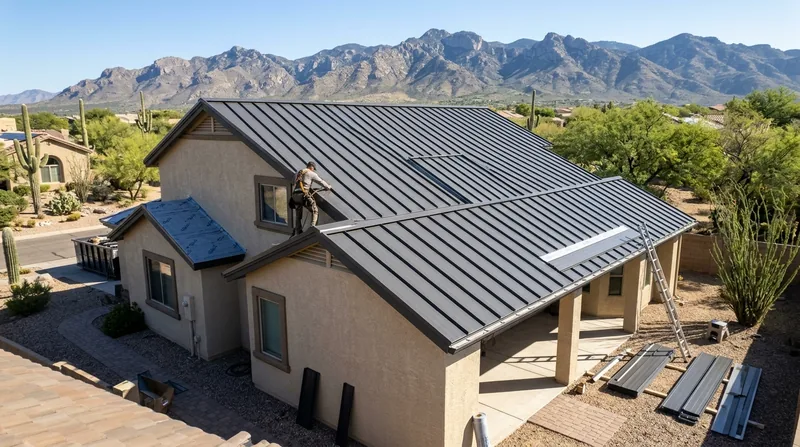




If you live in Tucson, you already know the sun is not gentle. A shingle roof on a 1970s ranch home in Flowing Wells or a foam roof in Midtown takes a beating from more than 100-degree summer highs, hard UV, and daily temperature swings that bake sealants and back out fasteners. That is why more homeowners across Pima County are moving to Metal Roof Installation in Tucson, a system built for this desert valley and the monsoon storms that roll off the Santa Catalinas and Rincons from July through September. We install panels engineered for intense UV, gusty outflow winds, dust walls, and occasional hail, with high-temperature synthetic underlayment, proper attic ventilation, and manufacturer-approved flashing details. Whether your home is a stucco bungalow in Sam Hughes, a Spanish Colonial Revival with clay tile in Colonia Solana, or a newer subdivision house in Vail or Sahuarita, a correctly installed metal roof delivers a 40 to 60 year service life instead of another decade of patching. Call (520) 467-0179 for a free on-site assessment, or review our standing seam metal roofing options before you decide on a profile.
Why Metal Roof Installation Matters in Tucson's Desert Valley
Tucson sits at about 2,400 feet in a Sonoran Desert valley ringed by four mountain ranges, and that geography drives the roofing problem. Year-round UV degrades asphalt shingles and foam within a decade, while the daily swing between hot afternoons and cool nights works screws loose and cracks old sealant. Monsoon outflow winds and sudden cloudbursts find every weak flashing detail, especially on low-slope roofs that were never built for standing water. A metal roof installed to manufacturer spec handles all of it.
- Reflective finishes and vented assemblies cut attic heat gain during June afternoons when the valley floor pushes past 105 degrees.
- Standing seam panels with concealed fasteners resist monsoon wind uplift far better than exposed-fastener systems on open desert lots.
- Metal sheds dust and pollen from mesquite and palo verde without the granule loss that ruins shingles under hard desert sun.
- Correctly flashed penetrations around chimneys and skylights stop the leaks that plague older adobe and block homes in Barrio Viejo and Armory Park.
We size panels, underlayment, and ventilation to the actual roof, not to a generic template, because a Catalina Foothills home with a tile pitch and a south-side ranch with a low slope need different assemblies.
Key info: A homeowner in Drexel Heights was replacing shingles every 12 years on a west-facing slope. After a standing seam installation with high-temp underlayment and ridge venting, attic temperatures dropped measurably and the roof stopped shedding granules into the gravel yard.
Before any work starts, verify local requirements with the City of Tucson building department, since permit thresholds and inspection rules vary by jurisdiction and historic district.
How We Install Metal Roofs on Tucson Homes
Every installation follows the same disciplined sequence, adapted to the home in front of us. We start with a tear-off and deck inspection, because rotted sheathing under an old shingle or foam roof will telegraph through new panels. Then we build the weather barrier, ventilation, and flashing before a single panel goes down. The order matters more than the speed.
- We remove the existing roof covering and inspect the deck for soft spots, then replace damaged sheathing.
- We install high-temperature synthetic underlayment rated for desert heat, not standard felt that sags and tears.
- We set ice-and-water membrane at valleys, eaves, and penetrations where monsoon water concentrates.
- We build or replace flashing at chimneys, skylights, and sidewalls to manufacturer details.
- We install panels with the correct clip spacing and fastener torque for the local wind zone.
- We add ridge and soffit ventilation so the attic can exhaust the heat the metal reflects.
- We walk the roof, water-test the penetrations, and clean the site before we call the job done.
This sequence is why our installs hold up through monsoon season rather than leaking after the first big storm.
Key info: On a 1990s stucco subdivision home in Oro Valley with a concrete tile roof, we converted to a stone-coated steel profile in a Spanish tile pattern. The HOA approved the color and profile, and the homeowner kept the look while cutting the weight and maintenance load.
If your existing roof is still sound, a metal roof over shingles retrofit can save tear-off time, subject to code limits on existing layers.
Installation Approaches We Use Across Tucson
The right system depends on your roof pitch, your budget, and how visible the roof is from the street. We install four main approaches across Pima County, and we will tell you honestly which one fits your home instead of upselling the most expensive option.
| Approach | Description | Best for |
|---|---|---|
| Standing seam | Concealed fasteners, raised seams, clean vertical lines | Primary homes, low slopes, high wind exposure |
| Exposed-fastener R-panel | Ribbed panels screwed through the face, economical and fast | Carports, ramadas, workshops, outbuildings |
| Stone-coated steel | Steel panels with a stone granule finish in tile profiles | HOA subdivisions, Spanish tile look, hail resistance |
| Metal shingles | Stamped panels that mimic shake or slate with interlocking seams | Historic-adjacent homes, complex roof geometry |
| Copper accents | Soldered copper for porches, bay windows, and small feature roofs | Period homes, high-end accents, long service life |
Each approach carries different material and labor costs, and we walk you through the tradeoffs before you commit.
Metal Roof Installation Cost in Tucson: What to Expect
Most Tucson homeowners want a number before they want a brochure, so here is the honest starting point: metal roof installation begins around $8 per square foot installed, and the final figure depends on the system, the roof, and the site. A simple gable on a Vail subdivision home sits near the low end. A complex Catalina Foothills roof with multiple valleys, skylights, and a steep pitch moves toward the high end. Exposed-fastener R-panel on a detached workshop in Picture Rocks costs less per square foot than standing seam on a primary residence.
Several factors move the price more than anything else. Roof pitch and geometry affect labor hours. Tear-off of multiple existing layers adds disposal and deck repair. Access matters on desert lots where a truck cannot reach the back of the house. Historic district or HOA design review can require specific profiles and colors that cost more. Attic ventilation and flashing upgrades add scope but prevent expensive leaks later.
Getting two or three written estimates is the smartest thing you can do. It keeps pricing honest and lets you compare what is actually included, not just the bottom line. See our full metal roofing pricing overview for a detailed breakdown.
Key info: A homeowner in Green Valley received three quotes that differed by nearly 40 percent. The cheapest one excluded deck repair and used standard felt underlayment. The written scope comparison made the real difference obvious.
What to Look for When Hiring a Metal Roofing Contractor Near Tucson
Hiring the right crew matters as much as choosing the right panel. Start with licensed and insured status, and ask for the certificate rather than taking a verbal assurance. Get at least two or three written estimates with itemized scope, not a single lump-sum number. Ask for local references on homes similar to yours, and call them.
Understand the permit picture before work begins. Full replacements and re-roofs commonly require a permit, and thresholds vary by jurisdiction, so confirm with the local building department. If your home sits in a historic district or an HOA, design review may restrict panel profile and color. A contractor who knows Tucson should raise that before you sign, not after materials arrive.
Ask how the crew handles monsoon timing, deck repair, and cleanup. A written contract with a clear scope, start date, and warranty terms protects you. Reach out through our contact page to schedule a free assessment.
Metal Roof Installation Near Me: What Tucson Homeowners Should Know
When you search for metal roof installation near me, you are really asking who will show up, do the work correctly, and stand behind it. In Tucson, that means a crew that understands desert heat, monsoon wind, and the specific roof types found from South Tucson to Catalina Foothills. Ask about underlayment ratings, fastener specifications, and ventilation design. A contractor who can answer those questions in plain language is usually the one worth hiring. Call (520) 467-0179 to talk through your roof.
Metal Roof Installation in Tucson: Pricing Guide
| Service | Price | Details |
|---|---|---|
| Standing seam installation | Starting at $8/sq ft | Includes concealed fasteners, high-temp underlayment, and flashing; pitch and roof complexity move the price |
| Exposed-fastener R-panel | Starting at $6/sq ft | Economical ribbed panels for carports, ramadas, and outbuildings; panel length and access affect cost |
| Stone-coated steel or metal shingles | Starting at $9/sq ft | Tile and shake profiles with granule finish; HOA-approved colors and complex geometry raise the figure |
| Tear-off and deck repair | Quoted per project | Removal of existing layers and sheathing replacement; number of layers and rot extent drive the number |
| Travel | Included | In Tucson and surrounding Pima County areas, no separate call-out or mileage fee |
| Estimate | Free | Response within 24h at (520) 467-0179, no obligation to book |
Indicative pricing, the exact cost depends on square footage, finish, and site access. Free personalized estimate within 24h at (520) 467-0179.


