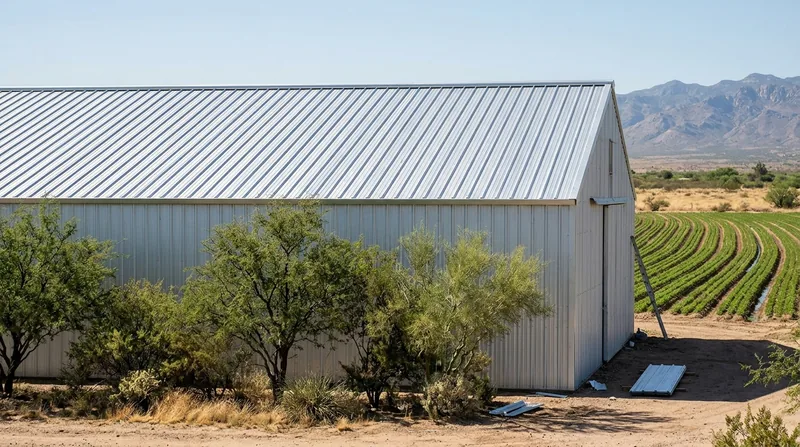




Tucson sits in a Sonoran Desert valley at about 2,400 feet, ringed by the Santa Catalina, Rincon, Santa Rita and Tucson Mountains, and that setting shapes every commercial and agricultural roof in Pima County. From ranchettes and pecan groves in the Santa Cruz valley to warehouses on the south side and workshops off the northwest corridor, buildings here face intense UV, summer highs above 100 degrees and wide daily temperature swings that bake sealants and back out fasteners. July through September monsoon storms bring sudden cloudbursts, gusty outflow winds and dust walls that test every panel and screw. For shops, barns, churches, carports and light commercial buildings, Commercial & Agricultural Metal Roofing in Tucson is the system that holds up to this climate when it is specified and installed for the desert rather than for a milder market. We install, repair and replace metal roofing on these buildings across Tucson and the surrounding communities, with panel systems, insulation and flashing sized to the actual loads the roof will see. If you are also planning work on a home or smaller structure, our metal roof installation in Tucson page covers residential scopes.
Why Commercial and Agricultural Metal Roofing Matters in the Tucson Valley
Commercial and agricultural roofs here are rarely simple. A pecan grove barn in Sahuarita may have a low-slope roof over equipment, a carport at a Midtown shop may span a wide bay with exposed fasteners, and a church near Armory Park may need a profile that respects a historic district review. The dominant failure mode in this city is UV and thermal cycling: sealants at penetrations and panel ends dry out and crack, fasteners back out of their holes, and the next monsoon gust or cloudburst finds the gap. Dust and grit also collect in pans and at curbs, holding moisture against metal after a storm. Metal is still the right answer for these buildings, but it has to be detailed for heat, sun and wind-driven rain, not for a coastal or foggy climate.
- UV and heat degrade sealants and coatings faster than in cooler markets, so we specify finishes and closures rated for desert exposure.
- Thermal movement works fasteners and panel laps loose, which is why screw replacement and re-fastening are routine on older exposed-fastener roofs.
- Monsoon outflow winds and dust walls test edge metal, ridge caps and fastening patterns on wide-span agricultural buildings.
- Hail and wind-driven rain during July to September push water sideways into penetrations and curb details that were never sealed for it.
- Building use matters: a workshop with equipment, a barn holding hay or feed, and a retail shop all need different insulation and condensation control.
We look at the building's use, span, slope and exposure before recommending a panel or profile, because a system that works on a carport in Flowing Wells may not be right for a church roof in Catalina Foothills.
Key info: A pecan grove barn near Sahuarita and a south side warehouse often fail the same way: dried sealant at penetrations, backed-out screws and grit packed against curbs. We inspect those details first, not just the panel field.
For permit thresholds and inspection requirements on commercial and agricultural roofing, verify current rules with the local building department before work begins, since fees and review steps vary by jurisdiction. A useful starting point for Pima County projects is the Pima County government site for department contacts and permit information.
How We Approach Commercial and Agricultural Metal Roofing in Tucson
Every job starts on the roof, not at a desk. We measure the actual slope and span, check the deck or purlins, look at how the building is used, and photograph the failure points: penetrations, curbs, edges, valleys and fastener lines. Then we match the approach to the building, whether that means a standing seam system on a shop, exposed-fastener R-panel on a ramada or carport, or a targeted repair on a barn roof that still has life in it.
- We inspect and document the existing roof, deck, insulation and flashing, and note access limits for equipment and lifts.
- We recommend a system based on slope, span, building use, budget and how long you need the roof to last.
- We pull the required permits through the local building department and coordinate any historic district or HOA design review before ordering panels.
- We remove or prepare the existing roof, repair decking and framing as needed, and install underlayment or insulation suited to the building.
- We install panels, edge metal, closures and flashing with fastening patterns and sealants rated for desert UV and monsoon wind-driven rain.
- We walk the finished roof with you, hand over documentation, and leave a clear maintenance picture for the building owner.
That sequence keeps surprises off the invoice and puts the right system on the building the first time.
Key info: On a workshop off the northwest corridor near Marana, a wide low-slope span with equipment inside called for a different panel and insulation package than the carport next door. We sized both to the building, not to a catalog default.
If the building is in a specific part of the metro, our commercial and agricultural metal roofing in Marana (85658) page shows how we handle that area's shops and outbuildings.
Approaches We Use on Tucson Commercial and Agricultural Buildings
The right system depends on slope, span, building use and budget. These are the approaches we specify most often on Pima County commercial and agricultural buildings, and each one solves a different problem.
| Approach | Description | Best for |
|---|---|---|
| Standing seam | Concealed-fastener panels with raised seams, clean lines and fewer penetration points. | Shops, churches and light commercial buildings where appearance and long service life matter. |
| Exposed-fastener R-panel | Ribbed panels fastened through the flat with screws and washers, economical and fast to install. | Barns, workshops, carports and outbuildings on larger desert lots. |
| Insulated panel system | Panels with insulation and condensation control built in for temperature and moisture management. | Buildings with equipment, stored goods or animals where heat and condensation are concerns. |
| Targeted repair and re-fastening | Replacing failed fasteners, resealing penetrations and repairing flashing on a roof with remaining life. | Older exposed-fastener roofs where the panel field is sound but details have failed. |
| Recover over existing roof | Installing a new metal system over a sound existing roof where code allows the added layer. | Commercial buildings where tear-off disruption and disposal costs need to be minimized. |
We confirm what the building department allows before recommending any recover, because code limits the number of existing layers a roof can carry.
Commercial & Agricultural Metal Roofing Cost in Tucson: What to Expect
Every commercial and agricultural roof is priced from an on-site look, and the estimate itself is free. The number moves with the square footage and slope, the panel system you choose, how much deck or purlin repair is needed, and how accessible the roof is for lifts and staging. Insulation, curbs, penetrations and edge metal add scope, and historic district or HOA review can add design and scheduling steps. Buildings with equipment inside may need work staged around operations, which affects labor.
- Size and slope drive material and labor more than any other factor on these buildings.
- Panel system choice (standing seam, R-panel, insulated) is the biggest line-item swing.
- Deck and framing condition can add repair scope once the old roof is open.
- Access and staging for lifts, deliveries and equipment protection affect labor hours.
- Penetrations and curbs for HVAC, vents and skylights add flashing work and sealant details.
Getting two or three estimates is smart on a building this size, and it helps to compare the same panel system and scope across bids. Our metal roofing pricing overview gives more detail on how we build a number.
Commercial & Agricultural Metal Roofing Near Me: Hiring a Contractor Near Tucson
When you search for commercial and agricultural metal roofing near me, the goal is a contractor who has actually worked on buildings like yours in this climate. Ask for proof of licensing and insurance, and get a certificate of insurance before work starts. Get more than one estimate and compare scope line by line, not just the total. Ask for references on similar buildings, whether that is a barn in Green Valley or a shop in South Tucson, and call them. Confirm who pulls the permit and how historic district or HOA design review is handled if your building falls under one. A contractor who answers those questions plainly is the one to hire.
To set up a walk-through, use our contact page or call (520) 467-0179.
Commercial & Agricultural Metal Roofing in Tucson: Pricing Guide
| Service | Price | Details |
|---|---|---|
| Roof inspection and written assessment | Free estimate | On-site inspection with photos of penetrations, fasteners and flashing, plus a written scope recommendation. |
| Targeted repair and re-fastening | Starting at $850 | Covers failed fastener replacement, resealing and flashing repair on a sound panel field; roof size and access move the price. |
| Exposed-fastener R-panel installation | Starting at $9.50 per sq ft | Includes panels, fasteners, closures and edge metal; slope, span and deck condition are the main cost factors. |
| Standing seam or insulated panel system | On estimate | Priced from an on-site look because span, insulation and penetration count vary widely by building. |
| Travel | Included | In Tucson and surrounding Pima County communities, with no separate call-out or mileage fee. |
| Estimate | Free | Response within 24 hours at (520) 467-0179, with no obligation to book the work. |
Indicative pricing, the exact cost depends on square footage, finish, and site access. Free personalized estimate within 24h at (520) 467-0179.


